'%3e%3cpath%20id='Vector'%20d='M93.7812%2017.4894V14.3231H90.5044V3.31441H93.7812V0.111223H104.679V3.31441H107.993V14.3231H104.679V17.4894H93.7812ZM94.8489%2012.924H103.612V4.67668H94.8489V12.924Z'%20fill='%23F0EEE4'/%3e%3cpath%20id='Vector_2'%20d='M68.546%2017.4894V3.31441H71.8228V0.111223H82.721V3.31441H86.0346V7.84304H81.6533V4.67668H72.8905V17.4894H68.546Z'%20fill='%23F0EEE4'/%3e%3cpath%20id='Vector_3'%20d='M45.4727%2017.4894V12.924H48.7496V9.72078H51.9896V7.84304H48.7496V4.67668H45.4727V0.111223H49.8173V3.31441H53.0941V6.48077H55.3032V3.31441H58.58V0.111223H62.9614V4.67668H59.6477V7.84304H56.4077V9.72078H59.6477V12.924H62.9614V17.4894H58.58V14.3231H55.3032V11.0831H53.0941V14.3231H49.8173V17.4894H45.4727Z'%20fill='%23F0EEE4'/%3e%3cpath%20id='Vector_4'%20d='M35.5857%2019.3338H26.7861H22.4416V21.6166H25.7184V23.8993H36.6534V20.6961H39.9302V0.0779219H35.5857V9.68747H26.7861V0.0779219H22.4416V11.0497H25.7184V14.2897H35.5857V19.3338Z'%20fill='%23F0EEE4'/%3e%3cpath%20id='Vector_5'%20d='M6.59045%2017.4894V14.3231H3.27682V7.84304H-9.53674e-07V0.111223H4.34455V6.48077H7.62136V12.924H9.86727V6.48077H13.1073V0.111223H17.5255V7.84304H14.175V14.3231H10.935V17.4894H6.59045Z'%20fill='%23F0EEE4'/%3e%3c/g%3e%3cdefs%3e%3cclipPath%20id='clip0_0_47'%3e%3crect%20width='108'%20height='24'%20fill='white'/%3e%3c/clipPath%3e%3c/defs%3e%3c/svg%3e)
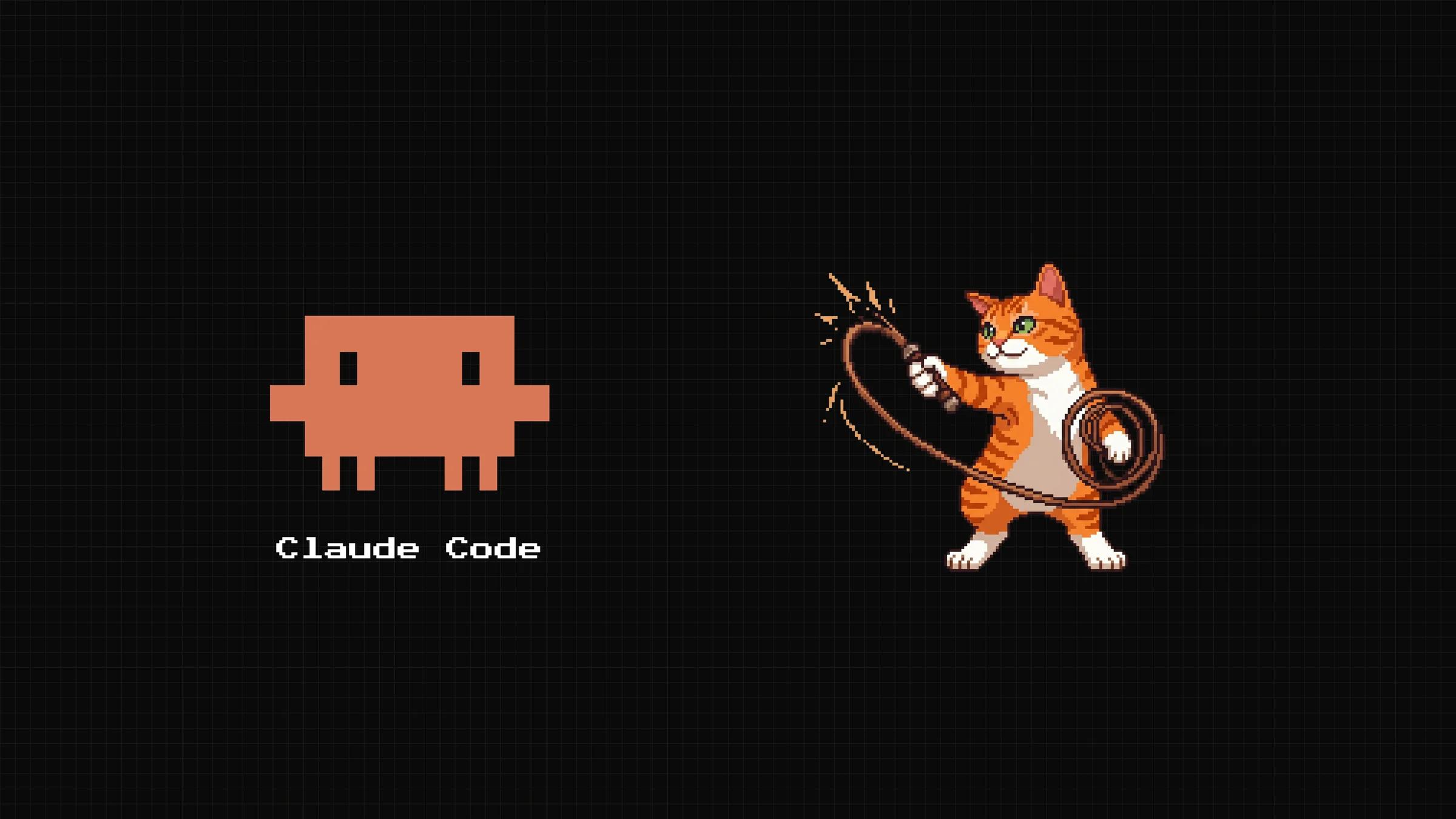
A person sits in front of a screen and literally "whips" the AI with an animated whip. On the screen is a window with the AI assistant Claude. After the hit, it goes into a panic: typing "FASTER FASTER FASTER" and calling itself a tin can.
Sounds like nonsense? Millions watched this in April. And the longer you ponder why this is needed, the clearer it becomes - the joke turned out to be unexpectedly spot-on.
// 01
The whip that strikes for real
One developer released a tiny program: it draws an animated whip over the screen, which can be "snapped" at the window with the AI assistant. The strike sends the command "stop," and a sarcastic message pops up on the screen saying "get moving already."
Childish? Absolutely. But that's exactly why it resonated: people had been frustrated for months that the smart assistant was lagging or hitting limits precisely when they urgently needed to finish a task yesterday. Someone finally figured out how to elegantly "release" that irritation with a single mouse click.
Videos with the whip gained millions of views in just a couple of days - faster than the AI could respond to them.
Next comes an almost detective story. A couple of days later, the company that makes this AI politely but firmly asked the author to remove its name from the program's title. It had to be renamed. And shortly after, a second version appeared - but a kind one: instead of insults, it praises the AI and tells it "I’m proud of you." A carrot and stick, in the literal sense.
// 02
What does the AI call itself
In the joke, the AI retorts with the word clanker - and this is not just a one-time joke, but a whole trendy insult for robots and neural networks. It means something like "tin can." The word is old, it appeared in the science fiction of the last century, and it was truly popularized by "Star Wars" - where it was used to refer to enemy robot soldiers.
A year ago, the word suddenly escaped from cinema into real life. People began calling delivery robots, voice assistants, chatbots "clankers" - usually with irritation that technology is taking jobs from humans. The word became so entrenched that even politicians seriously discussed it - in the context of whether to warn people that they are speaking to a robot, not a human.
// 03
If we set aside the jokes - what’s the point
Interestingly, the story is not about technology at all. It’s about us. We have become so accustomed to working alongside AI that we have subtly started to treat it like a living colleague - who sometimes stalls before a deadline or doesn’t understand on the first try. And with a colleague, you want to communicate in the language of emotions: to hurry them up, to scold them, and sometimes to sympathize.
And the main pain point here is actually simple - expectation. It’s not that the AI answers incorrectly, but that sometimes it responds slowly precisely when every minute counts.
// 04
How to speed up without a whip
If you really want the AI to work faster - the whip has nothing to do with it; much more boring things help:
Ask one thing at a time. One clear question gets through faster than a list of ten wishes in one go.
Explain the context once. Keep a short memo about the project handy - you won’t have to retell everything from scratch in every chat.
Plan first, then work. Revisions take much more time than the answer itself.
Don’t dump everything into one conversation. Different tasks - different chats, so the assistant doesn’t get confused by the old context.
In short
Does the whip really do something to the AI?
No, it’s just an animation over the screen. It doesn’t affect the assistant's actual work - pure entertainment.
Why was the company unhappy with the program's name?
It was about branding - using someone else's name in the title of a third-party program is not allowed, a common story with trademarks.
Where did the trendy insult for robots come from?
From old science fiction and "Star Wars," and it only became mainstream a year ago - a reaction to the increasing presence of technology around us.